What can I do when reading practice ends in tears?
By LookIt editorial team. Created with AI assistance. Published . General parenting information, not a diagnosis or individual medical advice.
When reading practice ends in tears, pause and ask which part felt hard. Next time, try a shorter turn, share a page, or let your child choose a familiar book. If it keeps happening, tell the teacher what you notice and ask which words or skills would be useful to practise together.
Start with the line that felt hard
Your child reads the first page, gets stuck on the same word twice and pushes the book away. Put a bookmark there. Try, “That word was hard work. Would you like me to finish the page, or shall we leave it here?” You can come back to the word another day.
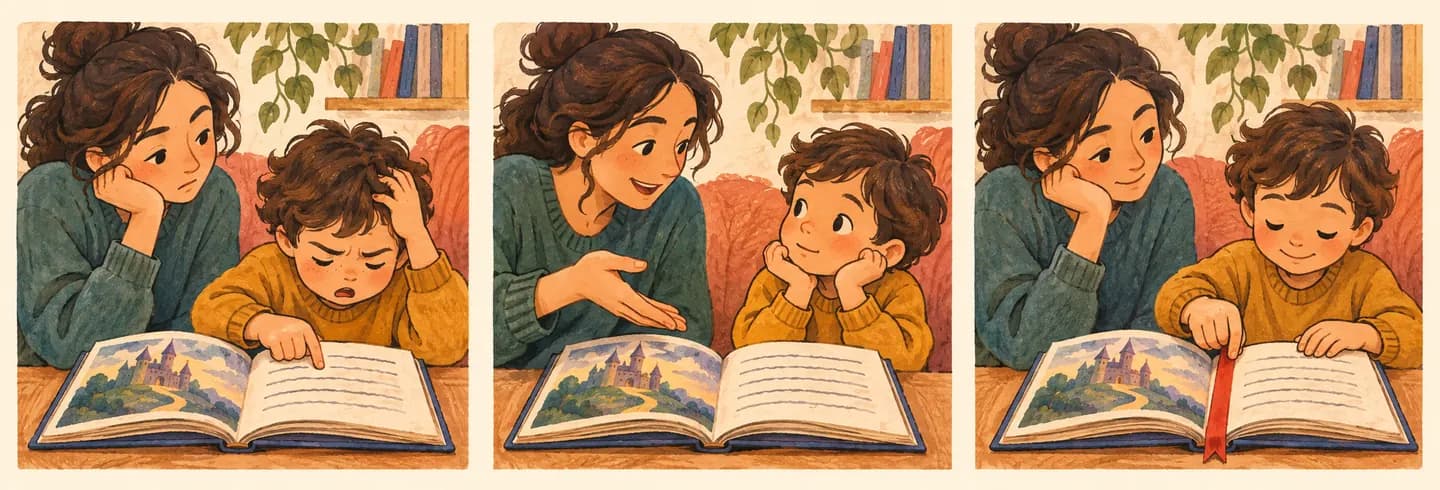
Try one small change
At the next practice, offer a smaller turn. Read the first page and invite your child to read a favourite line. Or let them choose a familiar book and tell you when they want you to take over. If a few lines go well, that can be a good place to stop. The stopping point can change with the book and the evening.
Let some reading time belong to the story. If your child wants to talk about the picture or guess what the dog will do next, follow that conversation. Researchers studying shared picture-book reading investigated language development in young children. Their study does not establish a time limit for reading practice. Whitehurst and colleagues’ picture-book study
What to bring to a conversation about reading
A note can be as simple as this: “Yesterday we read the page together and she wanted to turn over. Tonight she tried the same page on her own and wanted to stop at the second line.” Share the page or the book title with the teacher. That gives you a specific place to start when you talk about what to practise next. Reading below grade level when practice feels like a fight
When to seek help
If the same difficulty keeps bringing practice to a halt, take an example to school. “She can tell me what the story is about, but she gets stuck sounding out these words. What are you practising in class, and what could we try at home?” That conversation can help you choose a suitable book or work out whether your child needs more support.
Document-level references are not listed for this article. How we use sources and review answers.
Questions parents also ask
My child reads below grade level and treats reading like a punishment, how do I help them catch up?
A child who's behind in reading needs two things that are easy to blur together: practice pitched just a little above what they can do alone, and a live love of stories that you keep alive by reading to them well above their own level. Protecting that love of stories is what makes the practice bearable.
Read the full answer →How do I stop my toddler or preschooler from grabbing books, including ones I'd rather they not read, during the morning rush?
This is a good problem to have, your child loves books so much that mornings and mealtimes are competing for their attention. Wanting to manage which books are available when isn't overparenting or a sign anything is wrong: at this age, physically curating access is the main tool caregivers have, because kids this young can't yet override the pull of a favorite thing on their own.